4 Reasons to Dance

Kids need to move - we all know that. And yes, GoNoodle is a wonderful brain break for the kids in the classroom. But using dance in the Music room is different.

Phyllis Weikart is the accepted authority on using pattern dances in the music class. Her Rhythmically Moving series is the ultimate source for step by step instructions for folk dances from ALL over the world.

But when your principal walks by your room and questions why your students are movin' and groovin', here are 4 valid reasons to give to him or her.

1. It's truly engaging. The idea is simple. All of us retain whatever we are learning if we are truly interested. Because dancing is so enjoyable, your students will be focused and joining in the fun. Even reluctant students will see their classmates have a blast and they won't be able to stop themselves from giving it a try.

2. Kids are actively listening, not passively sitting. Now knowing how to listen to music in a concert is definitely a desired skill to have your students master. This kind of listening is different. Students must listen to the music in order to move at the correct time. They listen for melodies, repeated sections and changes in phrases and tempo. And they can demonstrate with their bodies that they are understanding what they are hearing.

3. Dancing is social. Brain research tells us that we are social creatures and we retain material better when we are participating and sharing it with others. It requires using appropriate behavior. It encourages cooperation and support among all peer groups. When students make mistakes, their classmates are ready to help them get back on track in order to keep the dance going. Students frequently laugh at their own mistakes so the stress level of trying something is reduced, even eliminated.

4. Dancing exposes kids to music from all over the world.
The Music Education National Standards mention becoming familiar with folk music from all cultures. As we know, music, particularly from our own personal background, evokes emotion. Connecting students to music of different heritages brings an understanding on this more emotional level as well as an intellectual one.

Introducing dance into your music curriculum is sound pedagogy It's also really enjoyable!

As always, I'd love to know if you've used dance in your music classes. Please leave a comment below.

Happy Honking! Ellen

Smart Organization: the Smart board

Smart boards are a GREAT tool in the Music room! If you are one of the lucky ones to have a Smart board in your room or in the rooms where you teach, it can make your lessons flow and keep you on track.

If you have no Smart board BUT you do have a projector and screen you can use this same strategy using Powerpoint or Google Slides.

This saves you from hauling a dozen posters with you to every room you teach in. It's in the cloud or on your flash drive. Let's take a look at this amazing tool slide by slide.

1. The board is displaying a message for your students to read as soon as they enter your room, ie. What can you tell me about Mozart? Or can you name a percussion instrument and explain how to play it?

I love "would you rather"s. Rachel Lynette has a bunch of free ones.


After briefly discussing the responses, you continue with the next slide.

2. In this slide there are pictures that link to various song lyrics in Powerpoint or other Smart Notebook files. Each picture represents a song for a grade level so if you teach 5 grade levels then you have 5 pictures.

I totally LOVE Music K-8 magazine!
They have created the powerpoints for you!

3. Rhythmic reading can be slide 3 (and 4, 5, etc. depending on how many grades you have.) One slide for each grade level. Rhythmic passages that scaffold from one grade to another help to keep you on track when teaching multiple grades. Students read the rhythms with syllables, clap them, and even add hand percussion.


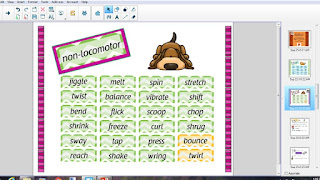
4. Following the rhythm slides are the slides that display the main activity of each of your lessons. These are the slides where you have different types of locomotor and non-locomotor movements for 2nd grade. Or on the next slide you might visually break down the 3 body percussion parts of the 5th grade piece.


Make it interactive. Have the kids come to the board and circle their choice.
Thanks to David Row at Making Moments Matter.

5. Nearing the end of your music lesson, you might calm everyone with a listening activity. Slides that introduce or review a certain style of music or specific composer.


Or again make it interactive


Now you have reached the end of your lesson. Your students exit your room and you start the presentation all over with the next class. If you have different grade level classes every period, this can really save your brain! 

It's all contained in one place. 

It goes in the order YOU want the lesson to go. 

It is highly visual in a class that is basically auditory. 

It gives your students something to look at while learning and listening.

Does creating this presentation take time every week or every 6 days or however your schedule falls? Yes it does- the 1st year! Is it worth it? ABSOLUTELY! Just like writing plans or creating lessons takes time, it is an investment in your future as a teacher. The beauty of these presentations is that once you've made them, you can use them next year and over and over. It bears repeating - it is totally worth your time.

If you do something different that works for you, I would LOVE to see it the comments below!

Happy Honking! Ellen

Parent Contact: the Phone Call (with a script!)

Following up on last week's post "The Secret to Parent Contact", I'd like to share another way to make positive connections with parents....the phone!

Positive phone calls home are great for a few reasons.

1. If you tell your students that you will be watching the class and making one positive phone call home to someone's parent, it is amazing how motivated students become to impress you in order to get that phone call. (sa-weet management strategy)

2. Parents LOVE to hear compliments about their kids! After all, your students are someone's "pride and joy". Who doesn't want to hear someone else find their child doing a great job?! And especially the teacher!

3. By calling the parent or even leaving a voice mail, you have made the first step toward establishing a good working relationship. Later if you need to make a call regarding the child's poor behavior, the parent knows that you are not just calling to complain. And let's face it, most calls from teachers to parents are about just that - poor behavior. If you have already shown the parent that you have seen the good stuff from the kid, they are more likely to support you when you call about some not-so-good stuff. You become a team, trying to shape this kid into a good human being. C'mon, that's one of the great things about teaching, right?

Don't be afraid of parent phone calls. And don't think that your input doesn't matter just because you are not the child's classroom teacher! IT DOES!

So...you chose one student a week or one per class. When do you find time to make these calls? Cause let's face it, there's never enough time. Choose a small block of time at the end of the day or end of the week.

Have the phone numbers ready and even a sheet of paper for a log to jot down whether you actually talked to someone or if you left a message. Then take a deep breath and make the call(s). It does not take much time to say a quick hello and praise their child. You leave the parent feeling good and you will feel awesome as well.

Eek! But what do you say exactly? 
Here is a sample script.

Hi, this is John Lee, the music teacher at Parker Elementary School. I'm calling about Jonah Smith. Is this Jonah's mother? I'm just calling today to tell you what a great job Jonah did in Music today. He was super helpful to his classmates, showing them the proper way to hold the recorder. He was patient and positive and his friends appreciated his help. I make one positive phone call each day (week) to share good news about a student, and today Jonah is IT! Would you please tell Jonah I called? He knows this is a big deal in my Music room and he will want to know! Thanks so much!

Be positive with a specific example of what the child did and why that was a good thing.

And voila - it's done! WIN-WIN! It's doesn't take much time at all and spreads really good mojo between you and your parents.

Give it a try! I'd LOVE to know how it worked for you!

Happy Honking! Ellen

The Secret to Parent Contact

Connecting with parents is such a powerful part of a teacher's job. Conversations and notes home are so important when establishing a relationship with parents. And when you're the one music teacher (or other special area teacher), you teach a whole lot more than 30 kids. So...how do you make contact with TONS of parents and not have it take TONS of time?

"brag tags" and phone calls

Brag tags are little pieces of paper with brief positive messages on them. You can write the messages or you have the messages pre-printed on the tags.
from Cara's Creative Playground

The easier way is use the pre-printed ones. Buy some fun Astro Brights paper and make copies. You'll get many tags on a sheet so you'll need to cut them down. I recommend finding the school's paper cutter or asking the art teacher if you could use the art room cutter. So much more efficient!

Hand out brag tags at the end of each class. Choose a FEW students who demonstrated behavior or character traits that you want everyone to show. Give them a brag tag. Record their names. A little check after each name on your roster is enough. The object is to give a brag tag to each student over time so you'll want to track this.

You're already thinking about some of your students who struggle to show appropriate behavior. How will they ever get a brag tag? You can give tags for effort, improvement or even stepping out of their comfort zone and trying something new.

Be sure to mention the reason the student is receiving the tag, ie. "Thomas I loved the way you helped Dylan on the recorder", "Ebony, you showed me you were really trying today", "Ayesha, I noticed you are working on your self-control. Keep up the good work!"

So...what do the kids do with these brag tags? Kids are proud to be recognized for doing something well. These tags can be stapled into their agendas, placed in take home folders or even displayed on the fridge at home. I encourage them to tell their parents about WHY they received the tags.


Brag tag templates can be found all over TPT and teacher blogs. In the past, I used Cori Bloom's Notes from your Music Teacher (link here) and Lindy DuPlessis's 35 Character Education Brag Tags (link here) Now I use Cara's Creative Playground's Growth Mindset Positive Notes (link here) .


In my next post, I will write about parent phone calls including a "script" for you to follow.


PSSSST! Next Thursday (and only Thursday), I will be giving you the chance to score my latest Musician in the Spotlight FOR FREE! Stop by my store and look for the newest product and download it for free! HINT: the musician is a MAJOR Country Music Star.

Happy Honking! Ellen

2 ways to create calm transitions in your classroom

When I first started teaching I was so concerned about music content and materials that I didn't really consider transitions or even protocols for activities. The kids behaved so calmly in the halls with their classroom teachers but once they came into my room, they forgot all about that.

I told myself that was OK because I teach music, right?
And music is a noisy subject, right?

But honestly it felt chaotic to me and it kinda wore me out. I didn't realize that having structure, procedures and protocols for behavior in my classroom didn't make me a control freak. It made me a good teacher.

I needed to take charge. After all this was MY room and I wanted to be comfortable in it. When I'd ask the kids to be "good", that wasn't specific enough. So I decided that my music room needed some FORMAL routines for pretty much EVERYTHING.

I created a step-by-step protocol for entering the room and exiting the room.
Posters of the entrance and exit routines were hung in the front of the room for visual cues.
 

And then we PRACTICED them a few times in each class and not just at the time of the transitions. I made sure that transition looked and sounded like I wanted it to. And if the behavior slipped once in a while, we would review the expectations and do the transition again and get it right.
LINING UP

I also chose CALM activities that came right after entering and right before leaving in order to make the transitions smoother.  For example, you will notice we do "brain hook-up" right after sitting down.

Later on I even added a poster listing the order of the activities in the music class so students could anticipate transitions.

Having the students know the expectations gave them a point of reference. They knew how they were supposed to enter, exit, hand out materials, collect materials, etc. And when they were ready, I assigned leadership roles to students to give them more influence in creating our classroom atmosphere. See my earlier blog on JOBS.

By giving students guidelines to follow, they knew what I wanted them to do and that made a world of difference for me.

Happy Honking! Ellen

4 Time Saving Hacks for Lesson Planning


I am one of those teachers who has to have a lesson plan. Yes I've had to "wing it" from time to time but I'm truly at my best when I have a plan.

Over the years, I have spent WAY too much time planning. Hours, days even thinking and rethinking. Finally I figured out how to create a good lesson plan in far less time and then have some time for other things.

I fill in the blanks! Yep it's that easy. Here's what I do.

1) use a template - include all the things I want to cover in every lesson, ie. rhythm, listening, singing

2) plug in my material, ie. songs I want to sing, rhythm, composer I want the kids to study

3) choose an music making activity - I love K&D GamePlan,
 I don't use all of their material but they have wonderful activities.
You could use music series texts or activities that you learned at a PD - just make sure YOU enjoy it. That energy will translate to your students. And... you might be teaching the lesson a few times so make sure you like it! 😉

4) look forward to having fun in your class without the stress of worrying what to do next. You know what you are going to do, you know what materials you'll want to use, etc.

I put all of my elements (songs, rhythm, etc.) into a Smart Notebook file and the lesson practically runs itself. (FLASH: More about the Smartboard in Music in another blog post.)

Here is an example of my template and how I fill it in.


They say....repetition, repetition, repetition...AND they are right. I choose a song (usually about the time of year or season) and we sing it for the whole month (3-4 times). By the 3rd or 4th time, the kids have heard it enough to sing it. I choose songs from Music K-8 magazine and I show the lyrics on the screen as a powerpoint.

I focus on a couple of rhythm patterns for each grade level and we practice them every class! I have an 8 measure rhythm example that includes several patterns that the grade level is working on. Yes, we say/clap it at each lesson for a month. Remember... repetition.

Then we do a music activity. Maybe we play recorders or boomwhackers or bar instruments or dance or ... something else. This is where I plug in a GamePlan activity.

Finally we do some listening to our monthly Musician in the Spotlight.

My kids LOVE this part of the lesson. I mix up the musicians with a different genre each month, ie. jazz, pop, soul, orchestral (what non-music folks might call "classical"), etc.

At the end of class, we do some rewards and housekeeping and the kids leave.

That's it! Easy-peasy. If you have any questions, please feel free to leave a comment.

Here's to less time doing lesson planning and more time doing what YOU want to do!

Happy honking!

How to Create Recorder Tutors

As I mentioned in my previous post (Recorder Belts...), I started using recorder belts to motivate my students to practice the recorder. It had a bigger impact than I expected. Actually all the kids wanted to do was play recorders - all the time! As much as I love these squeaky instruments, there were other songs/dances/activities that I wanted us to sing/dance/play.

Also after a while, I had a wide span of levels that all these kids could play. Some were just emerging while others were quite accomplished. So...I created Recorder Tutors. During each class, I chose a few students who were afraid to play in front of the whole class or who needed some extra attention and paired them with another few students who had mastered a higher level. Of course, EVERYBODY wanted to do this but I found it worked best with just a few.

So while the rest of the class participated in an entirely different lesson, tutorial tooting was happening.
 

I set them up in my "office", each pair on a music stand. The white packet of songs had letter names underneath the notes. These were for practice. I didn't let the students earn belts unless they could play the song without letters. If the tutor felt that the student was ready to play for a belt, they removed the white packet and used the yellow packet (no letter names). I even gave these tutors the authority to award belts. Very big deal to them!

This became so popular that tutors and "tutees" came to the Music Room at the start of the day before I had classes to play. I LOVED how much confidence was generated with this strategy! Both the tutor and tutee felt special and progress continued WITHOUT the teacher (my ulterior motive)!!

Side note: I no longer refer to playing on the recorder as tooting since that word now has the connotation of a certain bodily function and creates quite a round of  laughter when used. I call it HONKING. So as I tell my kids as they leave me...

Happy Honking!
Related Posts Plugin for WordPress, Blogger...